




For centuries, traditional Western biblical scholarship has largely operated under a Eurocentric framework, identifying the four empires of Daniel chapters 2 and 7 as Babylon, Medo-Persia, Greece, and Rome. Under this classical view, the terrifying “fourth beast” of Daniel 7 is assumed to be the Roman Empire, and the end-time Antichrist is expected to emerge from a “revived Roman Empire” in Europe.
However, a closer examination of both biblical geography and prophetic scripture challenges this assumption. When the text of Daniel is read through a Middle Eastern lens—focusing on the land of Israel and the regions surrounding Jerusalem—a compelling case emerges: the fourth beast of Daniel is not Rome, but rather the Islamic Caliphate, culminating in the Ottoman Empire.
1. The Geographical Center of Daniel’s Prophecies
To correctly identify the empires in Daniel, one must look at the geographical stage on which these prophecies operate. In Daniel 2, King Nebuchadnezzar sees a great statue representing four successive kingdoms, which are later parallelled as four beasts rising out of the “Great Sea” (the Mediterranean) in Daniel 7.
A critical detail is found in Daniel 2:35, which describes the final destruction of the statue when the Stone (Christ) strikes its feet:
“Then the iron, the clay, the bronze, the silver, and the gold were crushed together, and became like chaff from the summer threshing floors…” (NKJV)
Notice that all four empires—Babylon, Medo-Persia, Greece, and the fourth kingdom—are crushed together at the end of the age. This means the fourth kingdom must occupy the same geographical territory as its predecessors, absorbing them into itself.
- Babylon, Medo-Persia, and Greece all conquered and ruled over the Middle East—specifically modern-day Iraq, Iran, Syria, Turkey, Egypt, and Israel.
- The Roman Empire, while conquering the Mediterranean rim, never conquered the heartland of the Babylonian and Medo-Persian empires (Mesopotamia/Iraq and Persia/Iran). Its center of power was in Western Europe.
- The Islamic Caliphates and the Ottoman Empire, conversely, conquered and ruled the exact territory of Babylon, Medo-Persia, and the eastern Greek empire for over a millennium. They literally swallowed up the ancient empires into one cohesive geopolitical and religious system.
2. The Nature of the Fourth Beast (Daniel 7:7, 23)
Daniel describes the fourth beast as fundamentally different from the previous three:
“After this I saw in the night visions, and behold, a fourth beast, dreadful and terrible, exceedingly strong. It had huge iron teeth; it was devouring, breaking in pieces, and trampling the residue with its feet. It was different from all the beasts that were before it…” (Daniel 7:7, NKJV)
While Babylon, Persia, and Greece were pagan empires that largely allowed conquered peoples to retain their local gods, languages, and customs so long as they paid taxes, the Islamic Caliphate was uniquely religious, political, and legalistic. Wherever the Caliphates and later the Ottoman Empire expanded, they did not merely conquer territories—they “devoured” and replaced the indigenous cultures, languages (replacing Greek, Aramaic, and Coptic with Arabic), laws (implementing Sharia), and religions of the Middle East. It truly trampled the residue of the previous empires beneath its feet.
3. Changing “Times and Law” (Daniel 7:25)
One of the most specific prophetic markers of the “little horn” (the Antichrist) emerging from the fourth beast is found in Daniel 7:25:
“He shall speak pompous words against the Most High, Shall persecute the saints of the Most High, And shall intend to change times and law.” (NKJV)
No empire in history fits this description as precisely as the Islamic Caliphate:
- Changing Times: Upon the rise of Islam, the Caliphate abolished the solar and lunisolar calendars used by the Jews, Christians, and Romans, instituting the strictly lunar Hijri calendar. Even the weekly day of worship was shifted from the biblical Sabbath (Saturday) and the Christian Lord’s Day (Sunday) to Friday (Jumu’ah).
- Changing Law: Biblical law and Roman civil law were systematically replaced by Sharia (Islamic law), which governs every aspect of public and private life and explicitly subjugates Jews and Christians as second-class citizens (dhimmis).
4. The Rise and Fall of the Ottoman Empire (The Head Wound)
In Revelation 13, the Apostle John sees a composite beast that combines the features of Daniel’s four beasts—the leopard (Greece), the bear (Medo-Persia), and the lion (Babylon)—confirming that the final beast is a Middle Eastern conglomerate. John notes a crucial detail in Revelation 13:3:
“And I saw one of his heads as if it had been mortally wounded, and his deadly wound was healed. And all the world marveled and followed the beast.” (NKJV)
Historically, the Islamic Caliphate reached its zenith under the Ottoman Empire, which ruled Jerusalem and the Middle East for 400 years (1517–1917). Following World War I, the Ottoman Empire collapsed, and in 1924, Mustafa Kemal Atatürk officially abolished the Caliphate. To the Islamic world, this was a catastrophic “deadly wound”—for the first time in 1,300 years, there was no Caliphate ruling over the Middle East and Jerusalem.
Prophecy indicates that this deadly wound will be healed. Today, modern geopolitical movements across the Middle East, particularly centered around Turkey and regional alliances, openly speak of reviving the Caliphate and reclaiming Jerusalem.
5. The Legs of Iron and Feet of Clay (Daniel 2:41–43)
In Nebuchadnezzar’s statue, the fourth kingdom begins as legs of iron and ends as feet of iron mixed with ceramic clay—a divided kingdom that is partly strong and partly fragile, unable to adhere to one another (Daniel 2:41–43).
This accurately mirrors the historical and modern reality of the Islamic world:
- The Two Legs: Just as Rome divided into East and West, the Islamic Caliphate permanently fractured early in its history into two major branches—Sunni and Shia.
- Iron and Clay: Throughout the Middle East today, nations remain deeply divided along sectarian, tribal, and ideological lines. Though united by a shared religious identity, they “do not adhere to one another,” constantly fluctuating between fractured alliances and internal conflict, waiting for a strongman—the “little horn”—to unite them against Israel in the final seven years.
6. The Ultimate Goal: Jerusalem and the Temple Mount
Finally, Daniel’s prophecies are centered on “your people and your holy city” (Daniel 9:24)—Israel and Jerusalem. When the fourth beast tramples the earth, its primary target is the Jewish people and the Holy Land.
For centuries, it was the Islamic Caliphates and the Ottoman Empire—not Europe—that physically occupied Jerusalem, built monuments directly on the Temple Mount, and fulfilled Jesus’ prophecy that “Jerusalem will be trampled by Gentiles until the times of the Gentiles are fulfilled” (Luke 21:24). In the end times, the Antichrist will not come from Rome to invade Israel; rather, he will arise from the territory of the ancient empires surrounding Israel, seeking to wipe out the Jewish nation and establish his throne in Jerusalem (Daniel 11:45; 2 Thessalonians 2:4).
By shifting our perspective from Rome to the Middle East, the prophetic puzzle pieces of Daniel and Revelation interlock with remarkable precision. The fourth beast is not a distant European federation, but the historical Islamic Caliphate and Ottoman Empire—a sleeping giant whose deadly wound is poised to be healed on the doorstep of Israel in the final days.
Capturing Everyday Beauty
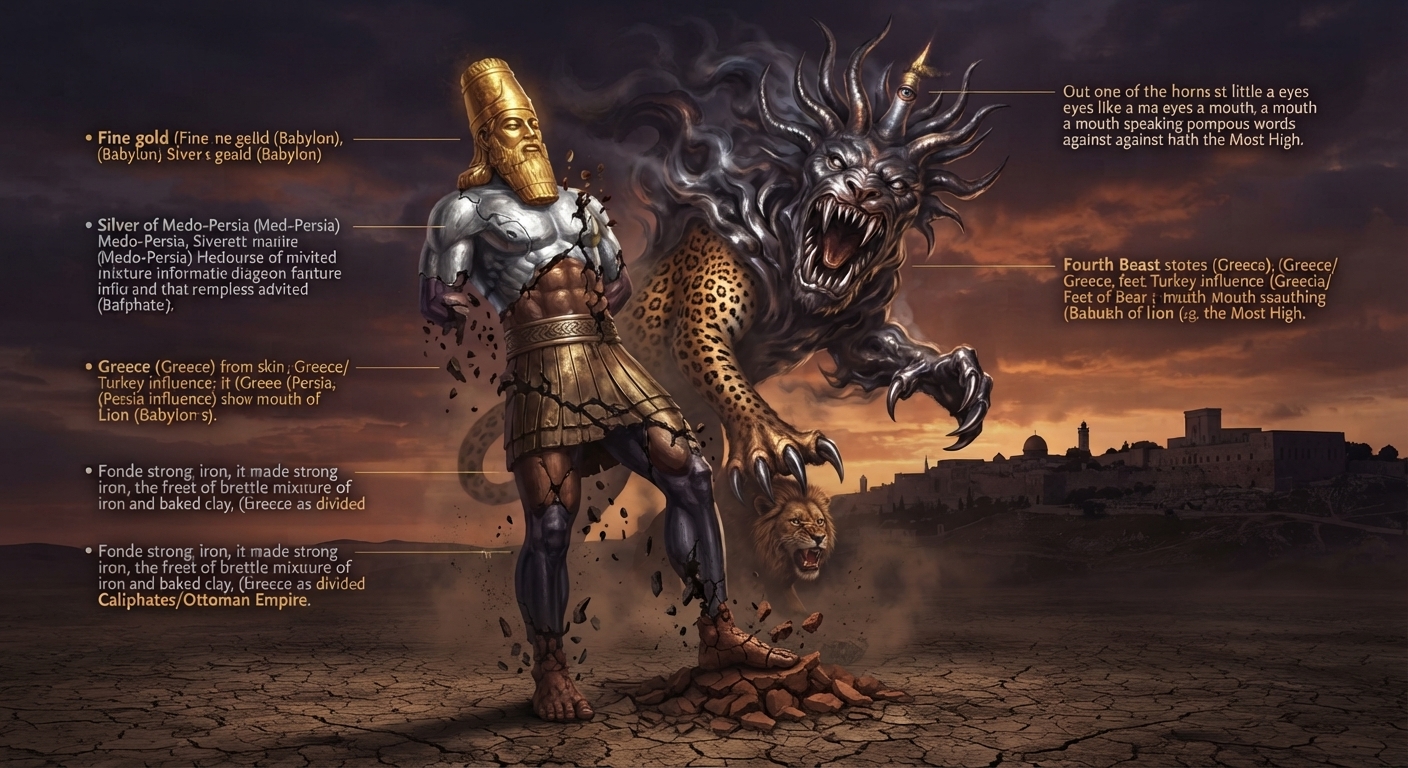
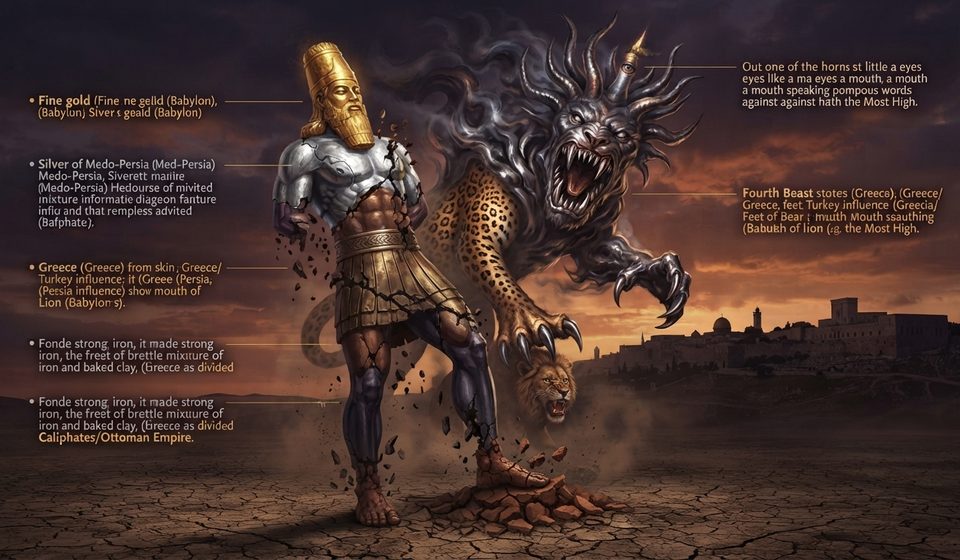
This illustration depicts the crumbling statue from Nebuchadnezzar’s dream, with its legs and feet representing the divided nature of the final empire. Rising behind it is the terrifying Fourth Beast, embodying the characteristics of the preceding empires (Lion, Bear, Leopard) but uniquely different in its religious and political totality.
A Gallery of Little Joys


Each picture tells a story. A warm drink, a good read, or the glow of a city after sunset—these are the tiny details that make life rich.
Words That Inspire
“Enjoy the little things in life, for one day you may look back and realize they were the big things.”
This simple truth reminds us that happiness is not found in grand events but in daily appreciation.
Video Inspiration (Image+Link)
Sometimes, watching a short video is enough to spark reflection and gratitude. Here’s one worth pausing for:

Video Inspiration (YouTube Embed)
Sometimes, watching a short video is enough to spark reflection and gratitude. Here’s one worth pausing for:
Small Daily Practices
- Take five minutes to notice your surroundings
- Write down one thing you’re grateful for each night
- Pause during your coffee break without checking your phone
Why It Matters
- Take five minutes to notice your surroundings
- Write down one thing you’re grateful for each night
- Take five minutes to notice your surroundings
- Write down one thing you’re grateful for each night
- Pause during your coffee break without checking your phone
- Pause during your coffee break without checking your phone
Mindful routines give structure to our days while teaching us to notice the beauty we often miss. Over time, this habit shifts how we see the world—not as a list of tasks but as a collection of meaningful moments.
Ready to Begin?
Start your own personal blog today and share your unique story with the world. Create Your Blog Now
Thank you for stopping by this demo post! This content mixes images, quotes, videos, lists, headings, and engaging text to demonstrate the versatility and beauty of your personal blog theme. Your clients can imagine their stories brought to life in this format.


Very good article…. hidden truths