



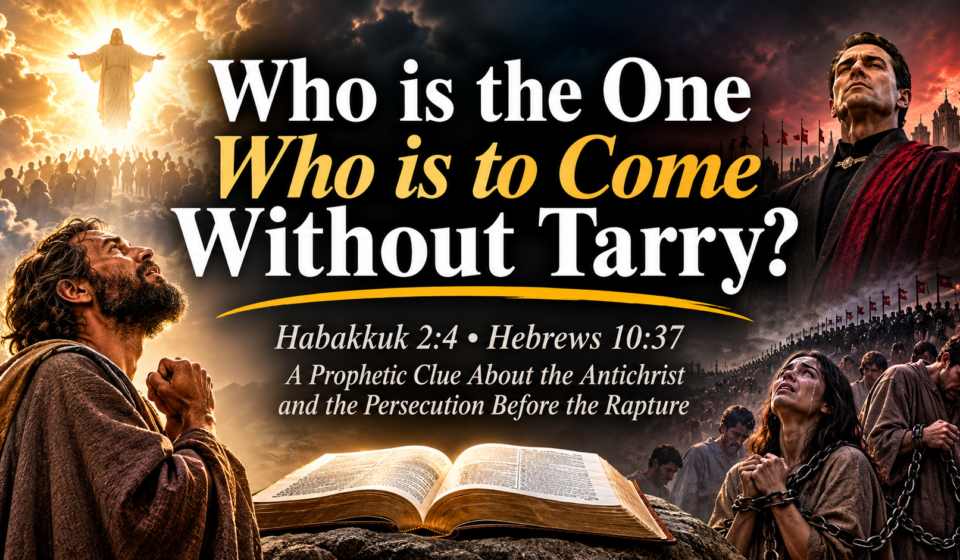

A closer examination of Habakkuk 2:3–4, Hebrews 10:37–38, the Antichrist, and the persecution of the saints before Christ’s return
Introduction: A question worth asking
There is a short but remarkable statement in Hebrews 10:37:
“For yet a little while, And He who is coming will come and will not tarry.” — Hebrews 10:37, NKJV
Most Christians understand this passage as a reference to the Second Coming of Jesus Christ. That interpretation has strong support in the immediate context of Hebrews, particularly the repeated emphasis on Christ’s return and the need for believers to persevere in faith.
But there is another question worth investigating.
What is the historical and prophetic background of the passage quoted by the writer of Hebrews?
Hebrews 10:37 is not an isolated statement. It draws upon Habakkuk 2:3, and the following verse, Hebrews 10:38, quotes Habakkuk 2:4. These two verses belong together. They must be examined in their original context before we draw conclusions about their New Testament application.
When we do so, we encounter a powerful prophetic pattern: an arrogant oppressor, the suffering of the righteous, an appointed time, the apparent delay of divine intervention, and the ultimate certainty of God’s judgment.
Could this pattern have significance for the persecution of God’s people under the Antichrist before the return of Christ?
Let us examine the evidence carefully.
1. The original setting: An oppressor and a suffering people
The book of Habakkuk opens with the prophet questioning God about the violence, injustice, and wickedness taking place in Judah.
Habakkuk cries out:
“O LORD, how long shall I cry, And You will not hear?” — Habakkuk 1:2, NKJV
The prophet is troubled because wickedness appears to prevail while God’s intervention seems delayed.
God’s answer introduces an unexpected instrument of judgment: the Chaldeans, or Babylonians.
Habakkuk 1:6 says:
“For indeed I am raising up the Chaldeans, A bitter and hasty nation Which marches through the breadth of the earth, To possess dwelling places that are not theirs.”
The Babylonians were a violent imperial power. They conquered nations, oppressed peoples, and exalted their own strength.
Habakkuk is then troubled by another question: how can a holy God use such a wicked nation as an instrument of judgment?
This is the background to Habakkuk chapter 2.
The prophet waits for God’s answer, and God tells him that the vision has an appointed time.
“For the vision is yet for an appointed time; But at the end it will speak, and it will not lie. Though it tarries, wait for it; Because it will surely come, It will not tarry.” — Habakkuk 2:3, NKJV
Notice the important elements:
- There is an appointed time.
- The fulfilment may appear delayed.
- The righteous are called to wait.
- The oppressor will not escape God’s judgment.
- God’s purpose will certainly be fulfilled.
This is not merely a message about an individual waiting for a personal blessing. It is a prophetic declaration concerning God’s appointed intervention against wickedness and oppression.
2. Who is the proud one in Habakkuk 2:4?
The next verse introduces a contrast:
“Behold the proud, His soul is not upright in him; But the just shall live by his faith.” — Habakkuk 2:4, NKJV
Two different characters are placed before us.
The proud one: His soul is not upright. He is arrogant, self-exalting, and unjust.
The righteous one: He lives by faith, trusting God even when circumstances seem to contradict God’s promises.
The following verses develop the character of the oppressor. Habakkuk 2:5–19 describes his greed, conquest, violence, exploitation, and idolatry.
The immediate historical reference is the Babylonian oppressor. We must not overlook that fact.
Yet the description is also significant because Scripture repeatedly uses the pattern of an arrogant ruler who exalts himself against God and persecutes God’s people.
Could Babylon’s ruler be more than a historical example of human arrogance? Could his character provide a prophetic pattern for a final enemy of God?
This is where the wider biblical testimony becomes important.
3. The prophetic pattern of the final oppressor
The Bible does not present the final enemy of God as an entirely new kind of character.
Daniel describes a ruler who speaks against the Most High and persecutes the saints.
“He shall speak pompous words against the Most High, Shall persecute the saints of the Most High, And shall intend to change times and law. Then the saints shall be given into his hand For a time and times and half a time.” — Daniel 7:25, NKJV
Daniel 8:23–25 also describes a fierce king who rises in opposition to God’s people.
In 2 Thessalonians 2:3–4, Paul describes the man of sin, the son of perdition:
“The son of perdition, who opposes and exalts himself above all that is called God or that is worshiped…” — 2 Thessalonians 2:3–4, NKJV
Revelation 13 presents a beast who blasphemes God and makes war against the saints.
“It was granted to him to make war with the saints and to overcome them.” — Revelation 13:7, NKJV
Compare these passages with Habakkuk 2.
The similarities are striking:
- An arrogant ruler exalts himself.
- He exercises oppressive power.
- God’s people suffer under his authority.
- His apparent success is temporary.
- God has appointed a time for his judgment.
The Babylonian oppressor in Habakkuk is not explicitly identified as the Antichrist. Nevertheless, the pattern of the proud persecuting ruler provides a meaningful comparison with the final persecutor described in Daniel, 2 Thessalonians, and Revelation.
This is a typological connection, not an explicit identification.
4. Why did the writer of Hebrews bring Habakkuk into the discussion?
Now we come to the central question.
Hebrews 10:32–34 reminds believers of their earlier suffering:
“But recall the former days in which, after you were illuminated, you endured a great struggle with sufferings.” — Hebrews 10:32, NKJV
The writer speaks of public reproaches, tribulations, imprisonment, and the loss of possessions.
These Christians were not being told that following Christ would guarantee a life without persecution. They were being encouraged to endure suffering without abandoning their faith.
Then comes the quotation from Habakkuk:
“For yet a little while, And He who is coming will come and will not tarry.” — Hebrews 10:37, NKJV
And immediately afterwards:
“Now the just shall live by faith; But if anyone draws back, My soul has no pleasure in him.” — Hebrews 10:38, NKJV
The connection is significant.
The writer of Hebrews is addressing believers who are suffering and need endurance. He uses the language of Habakkuk, where the righteous are also called to live by faith while an arrogant oppressor appears to prosper.
The message is clear: the apparent delay of God’s intervention must not cause the righteous to abandon their faith.
But what exactly is the coming referred to in Hebrews?
5. Is the Coming One the Antichrist or Christ?
Here we must distinguish between two questions.
First: Who is the Coming One in the direct meaning of Hebrews 10:37?
The immediate context of Hebrews strongly identifies the Coming One with Christ. Hebrews 9:28 speaks of Christ appearing a second time for those who eagerly wait for Him. Hebrews 10:37 is naturally read in that same expectation.
Furthermore, Hebrews 10:37 uses the language of Habakkuk 2:3 in its Greek form, applying the promise of the appointed coming to the Christian hope.
Therefore, it would be difficult to establish from Hebrews 10:37 alone that the Coming One is the Antichrist.
Second: Does the Habakkuk background have anything to teach us about the Antichrist and the persecution of believers?
Yes. This is where a wider prophetic comparison becomes possible.
Habakkuk’s context contains the pattern of an arrogant oppressor, the suffering of the righteous, and God’s appointed intervention. Daniel and Revelation develop a similar pattern in their descriptions of the final persecuting power.
The Antichrist’s persecution may therefore be understood as the final and climactic expression of the same kind of oppression that Habakkuk witnessed in his own historical setting.
In this broader sense, Habakkuk provides a prophetic background that deserves serious consideration when studying the persecution of the saints in the last days.
We should not confuse the oppressor in Habakkuk with the Coming One in Hebrews. The former may foreshadow the final enemy; the latter, in Hebrews’ immediate context, points to Christ.
6. The connection with the persecution before the gathering of the saints
The question of when believers will face the Antichrist’s persecution is central to the debate about the Rapture.
Some teach that the Church will be removed before the great tribulation. Others understand Scripture to teach that believers will face the persecution of the Antichrist before Christ gathers His elect.
Consider the words of Jesus:
“Immediately after the tribulation of those days… they will see the Son of Man coming on the clouds of heaven with power and great glory.” — Matthew 24:29–30, NKJV
Jesus then speaks of the gathering of His elect:
“And He will send His angels with a great sound of a trumpet, and they will gather together His elect from the four winds…” — Matthew 24:31, NKJV
Paul also describes the gathering of believers:
“For the Lord Himself will descend from heaven with a shout, with the voice of an archangel, and with the trumpet of God.” — 1 Thessalonians 4:16, NKJV
And in 2 Thessalonians 2, Paul discusses the coming of our Lord Jesus Christ and our gathering together to Him. He warns believers not to think that the Day has arrived without the prior revelation of the man of sin.
“Let no one deceive you by any means; for that Day will not come unless the falling away comes first, and the man of sin is revealed…” — 2 Thessalonians 2:3, NKJV
This passage deserves particular attention.
Paul connects the discussion of Christ’s coming and our gathering to Him with the revelation of the man of sin. He does not tell the Thessalonians to ignore the question of the Antichrist. Instead, he explains the events associated with that final period.
Revelation 13:7 also describes the beast making war against the saints.
Taken together, these passages provide substantial grounds for the Post-Tribulation understanding that the saints may face Antichrist persecution before the gathering of God’s people.
However, the argument for that chronology rests primarily on the combined testimony of Matthew 24, 2 Thessalonians 2, and Revelation 13—not on Hebrews 10:37 by itself.
7. Tribulation is not the same as God’s wrath
One of the most important distinctions in this discussion is the difference between persecution and divine wrath.
The Antichrist persecutes the saints. God judges the wicked.
Jesus warned His disciples:
“Then they will deliver you up to tribulation and kill you, and you will be hated by all nations for My name’s sake.” — Matthew 24:9, NKJV
Revelation 13:7 shows the beast making war against the saints.
But 1 Thessalonians 5:9 says:
“For God did not appoint us to wrath, but to obtain salvation through our Lord Jesus Christ.”
These statements are not contradictory.
Believers may experience persecution, suffering, and tribulation at the hands of evil powers without being appointed to God’s final wrath.
This distinction is essential when examining the Post-Tribulation and Pre-Wrath positions.
The Church’s suffering under persecution should not automatically be identified with God’s wrath against the wicked.
8. The real warning of Hebrews 10
We must return to the purpose of the passage.
Hebrews 10 is not written to satisfy curiosity about prophetic chronology alone. It is a warning and an encouragement to believers.
The writer says:
“Therefore do not cast away your confidence, which has great reward.” — Hebrews 10:35, NKJV
Then:
“For you have need of endurance, so that after you have done the will of God, you may receive the promise.” — Hebrews 10:36, NKJV
The context is unmistakable: endurance in the face of suffering.
The writer concludes:
“But we are not of those who draw back to perdition, but of those who believe to the saving of the soul.” — Hebrews 10:39, NKJV
This is a particularly serious message for the last days.
If the Church is called to endure persecution, then believers must be spiritually prepared. They must not build their faith upon the assumption that they will never face suffering.
The question is not simply whether we can identify the Antichrist. The greater question is whether we will remain faithful to Christ when the pressure to compromise becomes severe.
Conclusion: The appointed time will come
Habakkuk saw an arrogant oppressor and a suffering people. God told him that the vision had an appointed time and that the righteous must live by faith.
The writer of Hebrews took that message and applied it to Christians who were experiencing suffering and needed endurance.
Daniel, Jesus, Paul, and John provide further revelation about the final persecuting power and the suffering of the saints.
The biblical pattern deserves our attention:
- An arrogant power rises against God.
- The righteous suffer under oppression.
- God’s people are called to endure by faith.
- The appointed time of divine intervention arrives.
- The wicked face judgment.
- Christ appears and gathers His people.
We should therefore be careful not to make Hebrews 10:37 say something it does not explicitly say. The Coming One in its immediate context is Christ, not the Antichrist.
Nevertheless, the Habakkuk background opens an important prophetic comparison: the final Antichrist may repeat, on a much greater scale, the pattern of the arrogant oppressor who persecutes the righteous before God’s appointed intervention.
And this brings us to the central challenge of the passage:
Are we preparing only to escape the coming trouble, or are we preparing to remain faithful to Christ even if we must pass through persecution?
For the promise remains certain:
“He who is coming will come and will not tarry.” — Hebrews 10:37, NKJV
The oppressor’s time is limited. The suffering of the saints is not forgotten. God’s appointed time will come.
And the righteous shall live by faith.
Capturing Everyday Beauty

Photography is one of the best ways to capture fleeting everyday beauty. Even a walk through a quiet street can reveal colors, patterns, and perspectives worth remembering. The trick is not to wait for something extraordinary, but to find meaning in the ordinary.
A Gallery of Little Joys


Each picture tells a story. A warm drink, a good read, or the glow of a city after sunset—these are the tiny details that make life rich.
Words That Inspire
“Enjoy the little things in life, for one day you may look back and realize they were the big things.”
This simple truth reminds us that happiness is not found in grand events but in daily appreciation.
Video Inspiration (Image+Link)
Sometimes, watching a short video is enough to spark reflection and gratitude. Here’s one worth pausing for:

Video Inspiration (YouTube Embed)
Sometimes, watching a short video is enough to spark reflection and gratitude. Here’s one worth pausing for:
Video Inspiration (Vimeo Embed)
Sometimes, watching a short video is enough to spark reflection and gratitude. Here’s one worth pausing for:
Small Daily Practices
- Take five minutes to notice your surroundings
- Write down one thing you’re grateful for each night
- Pause during your coffee break without checking your phone
Why It Matters
- Take five minutes to notice your surroundings
- Write down one thing you’re grateful for each night
- Take five minutes to notice your surroundings
- Write down one thing you’re grateful for each night
- Pause during your coffee break without checking your phone
- Pause during your coffee break without checking your phone
Mindful routines give structure to our days while teaching us to notice the beauty we often miss. Over time, this habit shifts how we see the world—not as a list of tasks but as a collection of meaningful moments.
Ready to Begin?
Start your own personal blog today and share your unique story with the world. Create Your Blog Now
Thank you for stopping by this demo post! This content mixes images, quotes, videos, lists, headings, and engaging text to demonstrate the versatility and beauty of your personal blog theme. Your clients can imagine their stories brought to life in this format.
