



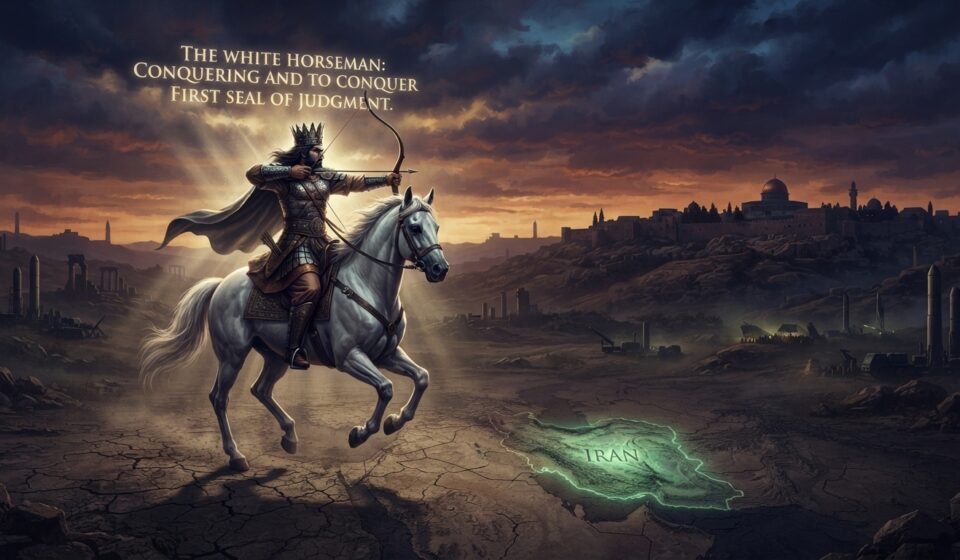

In the opening of the seven seals in Revelation chapter 6, the Apostle John witnesses a dramatic sequence of four horsemen. The first to ride forth is a figure mounted on a white horse, holding a bow, wearing a crown, and riding out “conquering and to conquer” (Revelation 6:2).
For centuries, commentators have debated the identity of this rider. While some early interpreters mistook him for Christ due to the white horse, a careful comparison with Revelation 19—where Jesus returns wielding a sharp sword from His mouth, wearing many crowns, and followed by the armies of heaven—proves the first horseman is an impostor. He is a counterfeit Messiah, representing the spirit of the Antichrist and the initial geopolitical surge that triggers the end-time tribulation.
When we examine the specific symbols associated with this rider alongside Old Testament prophecy, a striking geopolitical picture emerges—one that points directly toward modern Iran (ancient Persia / Elam).
1. The Symbol of the Bow: The Ancient Weapon of Persia and Elam
In Revelation 6:2, the rider is explicitly armed with a bow (toxon in Greek), notably without arrows mentioned—signifying conquest through intimidation, strategic alliances, and military posturing before outright global war (the Red Horse) erupts.
In biblical prophecy, the bow is the signature weapon specifically associated with Elam—the ancient region located in southwestern Iran, right along the Persian Gulf:
- Jeremiah 49:35: God declares against Elam, “Behold, I will break the bow of Elam, the foremost of their might.”
- Isaiah 22:6: “Elam bore the quiver with chariots of men and horsemen…”
Historically, the Persian Empire was world-renowned for its elite archers. By placing a bow in the hand of the first horseman, Scripture connects this initial conquering power to the ancient Persian/Elamite region—modern-day Iran.
2. The Crown of Conquest (Stephanos) and Regional Hegemony
The white horseman is given a crown—specifically a stephanos, the victor’s wreath worn by a conqueror—and goes forth “conquering and to conquer.”
Unlike the Red Horseman who immediately takes peace from the earth through massive bloodshed (Revelation 6:4), the White Horseman achieves bloodless or proxy victories through political dominance, ideological expansion, and strategic encirclement. Over the past decades, Iran has steadily expanded its “Axis of Resistance” across Iraq, Syria, Lebanon, and Yemen—effectively conquering and encircling Israel through proxy forces, asymmetric warfare, and ballistic/missile capabilities (the modern equivalent of the bow) without yet triggering a full-scale global conflagration.
3. The Islamic Eschatological Parallel: The White Horse of the Mahdi
One of the most compelling connections between Revelation 6 and Iran lies in Shia Islamic eschatology—the foundational state ideology of the Islamic Republic of Iran.
In Shia tradition, the ultimate end-time savior is the Twelfth Imam, or the Mahdi, who is believed to be hidden in occultation and whose return Iranian leadership actively seeks to hasten. According to Islamic traditions (Hadith), when the Mahdi emerges to conquer the world for Islam, establish a global caliphate, and march on Jerusalem, he will ride upon a white horse.
What the Islamic world awaits as its ultimate saviour riding a white horse, the Book of Revelation unmasks as the first seal of judgment—a deceptive conquering spirit that initiates the final seven-year tribulation.
4. The Connection to Ezekiel 38 and the Bear of Daniel 7
This Persian identification aligns seamlessly with other major end-time prophecies:
- Daniel 7:5: In Daniel’s vision of the four beasts, the second beast—representing Medo-Persia (Iran)—is depicted as a ferocious bear raised up on one side (the Persian dominance over the Medes) with three ribs in its mouth, commanded to “Arise, devour much flesh!”
- Ezekiel 38:5: When the prophet Ezekiel lists the coalition of nations that will invade Israel in the latter days under Gog, the very first ally named is Persia (Iran).
The White Horseman represents the catalyst that sets these coalitions in motion. His rise brings a deceptive veneer of religious righteousness (“white”) backed by military threat (“the bow”), paving the way for the Red Horse, Black Horse and the Pale Horse.
Conclusion
The White Horseman of Revelation 6 is not the Prince of Peace, but the precursor to the Antichrist’s global upheaval. Through the prophetic emblem of the bow of Elam, the strategy of proxy conquest, and the striking parallel to the awaited Mahdi of Shia eschatology, Scripture points believers to watch the Persian horizon. As tensions escalate around Jerusalem and the Middle East, the hoofbeats of the white horse remind the Church to remain watchful, discerning, and anchored in the true Messiah who alone brings lasting peace.
Life is often defined by big milestones, but the real beauty hides in the everyday moments we tend to overlook. A simple sunrise, the smell of freshly brewed coffee, or the laughter of a friend can add more joy to our days than we realize. By slowing down and appreciating these small details, we give ourselves the chance to live more fully.


Each picture tells a story. A warm drink, a good read, or the glow of a city after sunset—these are the tiny details that make life rich.
Words That Inspire
“Enjoy the little things in life, for one day you may look back and realize they were the big things.”
This simple truth reminds us that happiness is not found in grand events but in daily appreciation.
Video Inspiration (Image+Link)
Sometimes, watching a short video is enough to spark reflection and gratitude. Here’s one worth pausing for:

Video Inspiration (YouTube Embed)
Sometimes, watching a short video is enough to spark reflection and gratitude. Here’s one worth pausing for:
Small Daily Practices
- Take five minutes to notice your surroundings
- Write down one thing you’re grateful for each night
- Pause during your coffee break without checking your phone
Why It Matters
- Take five minutes to notice your surroundings
- Write down one thing you’re grateful for each night
- Take five minutes to notice your surroundings
- Write down one thing you’re grateful for each night
- Pause during your coffee break without checking your phone
- Pause during your coffee break without checking your phone
Mindful routines give structure to our days while teaching us to notice the beauty we often miss. Over time, this habit shifts how we see the world—not as a list of tasks but as a collection of meaningful moments.
Ready to Begin?
Start your own personal blog today and share your unique story with the world. Create Your Blog Now
Thank you for stopping by this demo post! This content mixes images, quotes, videos, lists, headings, and engaging text to demonstrate the versatility and beauty of your personal blog theme. Your clients can imagine their stories brought to life in this format.

